


Editor’s Note: This article is a translation of a special feature that complements an ongoing four-part series originally being published in Japanese. While this installment focuses specifically on the political landscape, the core series—currently being serialized—explores the gender gap from a broader range of perspectives. The original Japanese articles can be read here as they are released.
In October 2025, Japan reached a historic watershed moment: the appointment of its first female Prime Minister. Sanae Takaichi’s ascension to the premiership is an event that has etched a profound “change” into both the nation’s quantitative data and its qualitative social fabric.
In this special installment of our series, “Viewing the World through the 2025 Gender Gap Index,” we will explore the multifaceted impact of Prime Minister Takaichi’s leadership on Japan.
Our analysis will be conducted through two primary lenses that have defined this series: the “data”—specifically the impact on Japan’s Political Empowerment score in the Gender Gap Index (GGI)—and the “reality,” which encompasses the tangible influence of her policy orientation and leadership style on the nation.
Through these dual perspectives, we seek to move beyond the headlines and contemplate what the birth of Japan’s first female Prime Minister truly signifies for the country’s future.
Japan’s modern cabinet system was inaugurated 140 years ago, in 1885 (Meiji 18). While this marked the birth of Japan’s modern government, it established a leadership structure from which women would be entirely excluded for over a century. It was not until the aftermath of World War II, in 1946 (Showa 21), that women first secured seats in the National Diet. Another 14 years passed before Masa Nakayama made history in 1960 (Showa 35) as the first female cabinet minister.
Now, after an additional 65 years of waiting, 2025 (Reiwa 7) marks the ascension of Sanae Takaichi as the nation’s first female Prime Minister. While certainly an important milestone in Japanese history, what tangible impact will it have on Japan?
To answer this, we must first look through the lens of data—specifically the World Economic Forum’s Global Gender Gap Index (GGI). The GGI measures gender parity on a scale of 0 to 1, where 1 represents full equality. Japan’s overall rank has long hovered around 118th—the lowest among the G7, trailing far behind countries like Germany (7th) and the UK (14th). A primary cause is the Political Empowerment sub-score, where the variable “Years with a female head of state” carries a massive 44.3% weight. For Japan, this metric has remained at a flat 0 since the index began.
GGI Political Empowerment Metrics and Weighting
| Indicator | Weight |
| Percentage of women in parliament | 0.310 |
| Percentage of women in ministerial positions | 0.247 |
| Years with female/male head of state (last 50 years) | 0.443 |
Source: World Economic Forum, ”Global Gender Gap Index 2025”, p.73
If Takaichi remains in office for one year, this score will shift from 0 to 0.02 (representing 1 year out of 50). This would result in a 0.00886 increase in the political sub-score and an overall GGI score improvement of approximately 0.002 points. While a ranking shift of only one or two places may seem marginal on the surface, the context of moving from “0 to 1” (i.e., nothing to something) is profound. Even if the statistical impact is small, the shift can feel monumental in reality. Data is more than a snapshot of the present; it is a sedimentary record—a “geological layer” of society—that reveals the historical path a nation has trodden.
The fact of a “female head of state = 1” will now remain etched in Japan’s data for the next 50 years—and in the collective consciousness of its people. As this data point begins to move, the score has the potential to climb to 0.04, 0.06, or 0.08, depending on the longevity of the Takaichi administration or its ability to pave the way for future female leaders.
Japan, which had long remained frozen at the starting line, has finally taken its first decisive step forward. The birth of the Takaichi administration is a development that will refresh Japan’s data for decades to come. However, as we have observed throughout this series, a change in data does not inherently signal a change in social reality. Next, let us turn our attention to the “Reality”—the everyday lives of the Japanese people, the social structures, and the cultural mindsets that define the nation on the ground.
Sanae Takaichi’s first victory in a House of Representatives election was in 1993, eight years after the enactment of the Equal Employment Opportunity Law.
Data from a 1994 survey by the International Social Survey Programme (ISSP) reveals that at the time, the traditional value system—that “men should work and women should stay at home”—was still deeply entrenched in Japanese society.
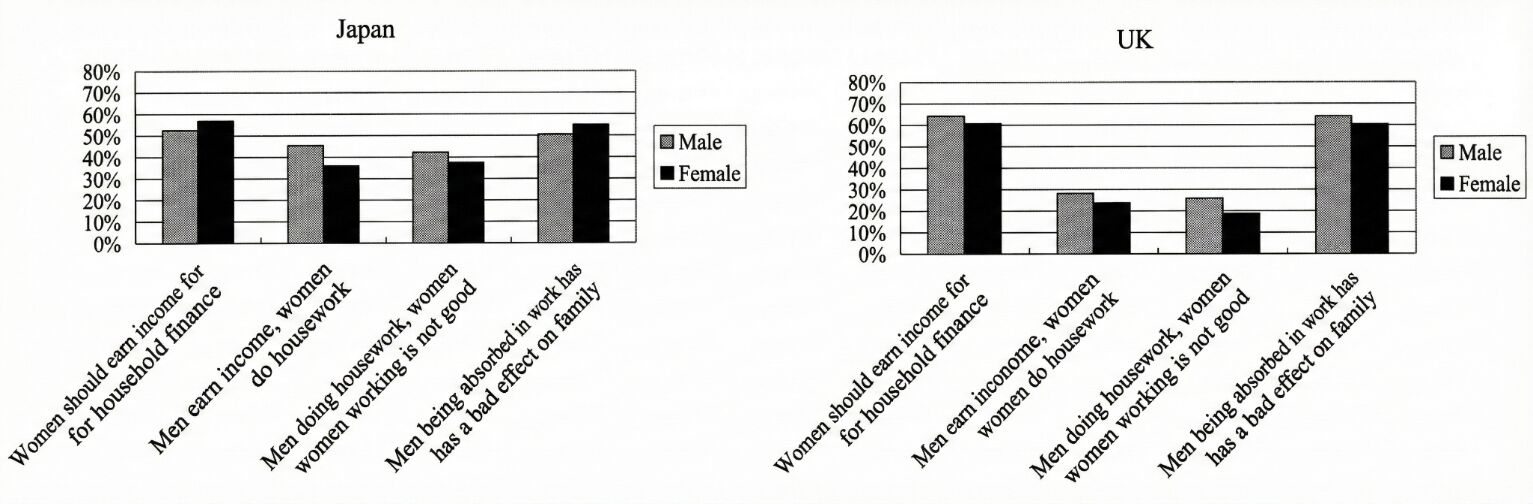
Source: Makiko Nishikawa, “A Study on the Labour Supply of Japanese Women in the 1990s,” p. 116.
Note: Translated from the original Japanese source.
In an era with few role models for women in the professional sphere, the “standard model” was a work style based on a rigid gender division of labor. The ideal worker was expected to be constantly “on,” offering complete devotion and self-sacrifice to their career. This mentality left virtually no space for family life; instead, it relied on the assumption that a worker’s domestic needs were managed entirely by a spouse at home. This was the era of the “24-hour warrior,” a mindset epitomized by the 1989 catchphrase for the energy drink Regain: “Can you be a ’24-hour warrior’?” (Ni-ju-yo jikan, tatakaemasuka?). This slogan was so culturally pervasive that it won a bronze prize at the 6th annual Buzzword of the Year awards (referencing Daiichi Sankyo Healthcare’s history of Regain).
Thirty-five years later, in 2025, Takaichi’s own remark upon her appointment as LDP President—“Work, work, work, and work” (Hatarai-te, hatarai-te, hatarai-te, hataraku / 働いて働いて働いて働く)—claimed the Grand Prize at the Buzzword of the Year awards (The Encyclopedia of Contemporary Words / T&D Insurance Group). This suggests that the fundamental work ethic demanded at the heart of Japanese politics has remained virtually unchanged.
The contrast between these two slogans from 1989 and 2025 highlights a sobering reality: the arena in which female politicians must compete has not yet broken free from the old standard that glorifies excessive labor and self-sacrifice. It could even be argued that by fighting to transcend traditional gender roles, these women have ironically internalized and inherited the very “ideal worker” norm of the past.
Given Takaichi’s career background, it is perhaps natural that she views this “male-equivalent model” as a blueprint for success. It is no surprise that she applies the same rigorous expectations of “Can you be a ’24-hour warrior’?” and “Work, work, work, and work” to herself. However, having a national leader embody this ethos risks reproducing this outdated standard across society. In this sense, Takaichi’s personal values and leadership style may have a paradoxically negative impact on the broader push for gender equality.
Furthermore, on the policy front, Takaichi is a staunch conservative. Her cautious stance on issues such as selective dual surnames for married couples and LGBTQ+ legislation means that the birth of a female Prime Minister does not automatically equate to more progressive policies regarding gender and identity.
This has led prominent feminists, including Chizuko Ueno, to remark that her rise is “nothing to be happy about,” sparking heated debate (as reported by Mainichi Shimbun: “Why we cannot celebrate a ‘Prime Minister Takaichi’—Ueno’s view on 80 years of women’s suffrage”).
Yet, viewing the rise of a conservative woman solely through a critical lens may overlook a significant shift. Takaichi’s breakthrough suggests that the traditional feminist framework of “women’s interests” and “equality” may no longer fully encompass the diversifying realities and political successes of women today.
The presence of a woman reaching the pinnacle of power within a conservative framework shatters the stereotype that “female politicians must be liberal and progressive.” It raises new, challenging questions regarding gender and ideology:
● Should a woman reaching the highest office be celebrated as a “victory” for empowerment, even if her values remain staunchly conservative?
● Does her success redefine the role of women by defying expectations from both sides—challenging traditional male views of leadership while also rejecting the “progressive” mold often expected of female leaders?
●If a woman achieves success by internalizing the “ideal worker” norm, does her victory ultimately serve to preserve and reproduce an outdated system?
The rise of conservative female leaders like Takaichi presents a new set of challenges hidden behind the revolution of women in
politics—questioning ideology, structure, and the true meaning of diversity.
*Note: The Social Impact of the “Buzzword of the Year” (Shingo/Ryukogo Taisho)
In Japan, the Shingo/Ryukogo Taisho (New Words and Buzzwords Awards) is more than just a pop-culture event; it is a significant sociological mirror reflecting the national zeitgeist of the year. Organized by the publisher of The Encyclopedia of Contemporary Words, the awards highlight phrases that captured the public’s attention and reflect the shifting values, scandals, or triumphs of Japanese society.
The fact that the 1989 “24-hour warrior” slogan and the 2025 “Work, work, work” slogan both received major awards underscores how deeply the “culture of overwork” is woven into the Japanese identity. For an analytical medium like Data no Jikan, these awards serve as qualitative data points that validate trends seen in quantitative labor statistics.
Given Takaichi’s ethos and political philosophy, is the shift in Japan destined to be merely statistical? Or is a transformation of social “reality” already underway—albeit in a form that challenges the long-held expectations of progressive politics?
Evidence suggests otherwise. Since taking office in October, Takaichi’s diplomatic presence, her composed yet articulate communication, and her dialogic leadership style have received high acclaim. According to a public opinion survey released by JNN on
November 3, her administration’s approval rating soared past 82% within just two weeks of its inauguration.
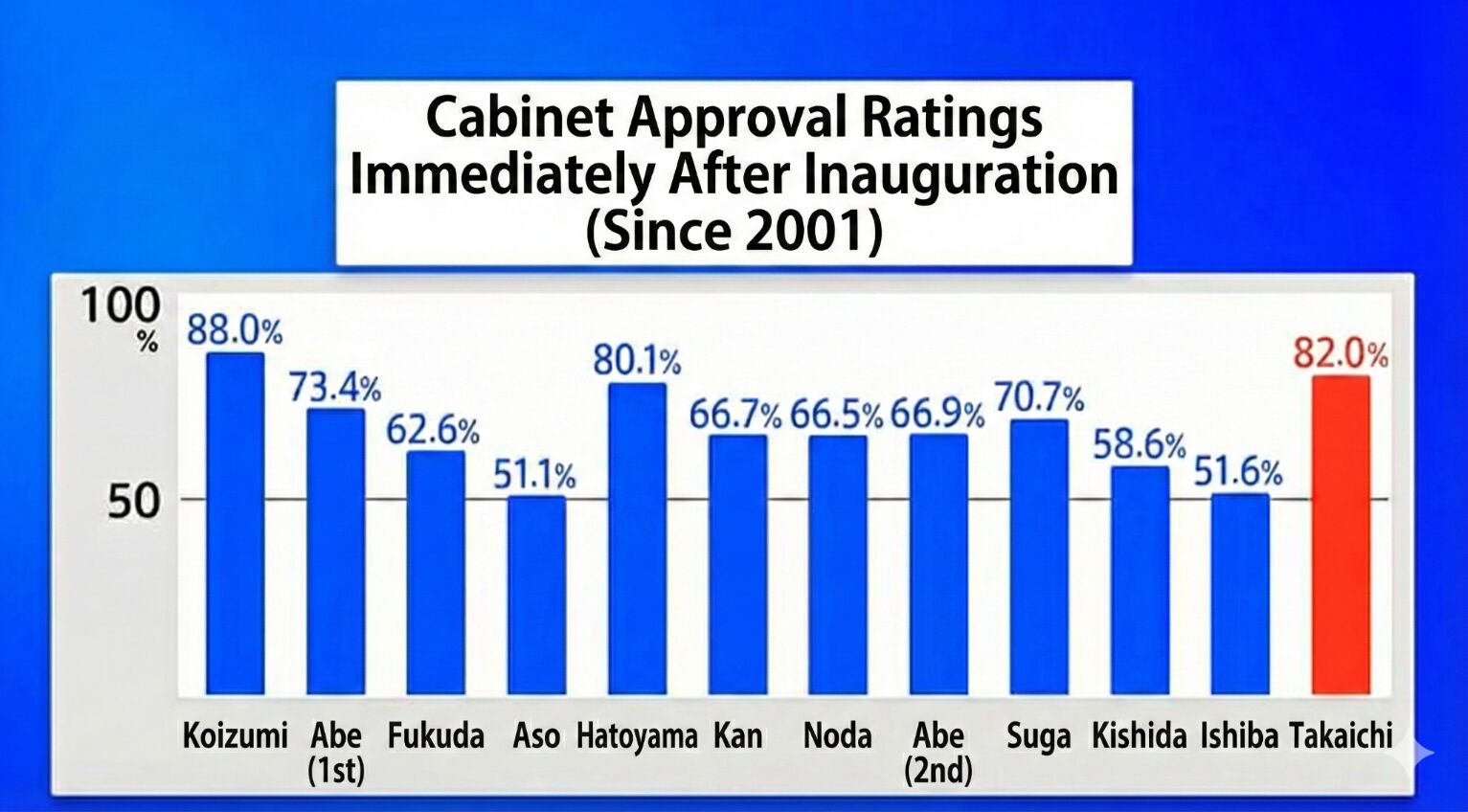
Source: TBS NEWS DIG, “Any blind spots for Takaichi cabinet’s record 82% approval rating? Signs of voter ‘return’ to LDP as public expectations rise [JNN Poll Analysis].“
Note: Translated from the original Japanese source.
The survey revealed an unprecedented level of enthusiasm across generations. When asked, “Do you have high expectations for Prime Minister Takaichi?”, over 80% of respondents aged 18 to 39 answered in the affirmative. Support remained robust among middle-aged and older demographics as well, with over 60% of those in their 40s and 50s, and over 50% of those aged 60 and above, expressing confidence.
This surge among younger voters is particularly noteworthy. A 2022 study by the Japan Center for International Exchange (JCIE) highlighted that compared to its Asian neighbors, Japan’s youth
(aged 18-39) have historically exhibited significantly lower levels of political interest.
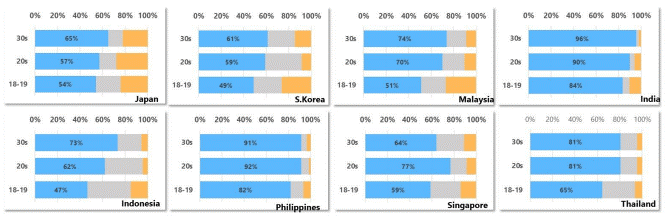
Japan (top left). Blue: “Interested”; Orange: “Not interested.”
Source: Japan Center for International Exchange (JCIE), “Survey Report on Political Awareness and Engagement of the Young Generation in Eight Asian Countries.“
In a nation where political apathy among the younger generation has long been considered an intractable issue, securing an 80% approval rating from this demographic suggests that Takaichi is successfully re-engaging the youth. This renewed interest is driven by a sense of speed in policy execution—exemplified by the agreement to abolish the gasoline tax just ten days after taking office—as well as the intense public focus on her work ethic, such as the “3 AM Work Protocol” (referencing the Asahi Shimbun report on her rigorous preparation for budget committee sessions).
Even if her policy agenda remains conservative, the “update” to the archetype of leadership in Japan has already begun. Regardless of whether specific gender-equality legislation advances, there is a distinct possibility that Japan may move in a positive direction
through other avenues: the restoration of international trust, economic stabilization, a shift in the tone of national dialogue, and the awakening of political consciousness among the youth.
As a self-made leader in a landscape dominated by hereditary dynasties, her rise is seen as a breakthrough of personal grit, offering a sense of strength that the public feels has been long overdue.
If one views the emergence of Japan’s first female Prime Minister solely through the lens of “gender,” Takaichi’s work ethic and policies might appear as those of a woman fighting within a traditional, male-centric framework. However, her ascent has already generated immense value by dismantling the binary trope that “female leaders must be liberal or progressive.” She has introduced a new layer of complexity into the discourse, irreversibly elevating the quality of the conversation surrounding gender and power.
If she is successful in steering the nation toward a positive trajectory—encompassing international relations, the economy, and social psychology—she may be remembered as more than just the “first woman” to hold the office. In doing so, she has the potential to be recorded in history as a leader who transformed both the data and the reality of Japan.
Even as this article was being written, the “data” continued to evolve. On December 10, Forbes released its list of the “World’s Most Powerful Women,” ranking Prime Minister Takaichi third—surpassed only by Ursula von der Leyen, President of the European Commission, and Christine Lagarde, President of the European Central Bank. Notably, Takaichi was the only Japanese woman to make the list.
Forbes lauded Takaichi as “a symbol of unyielding spirit in an era of volatility,” analyzing that “her decisiveness is pivotal to the
power balance of East Asia and the stability of global manufacturing.” From the moment the data shifted from “0 to 1”, it keeps gaining momentum (Reference: Forbes Japan).
The appointment of Sanae Takaichi is a historic milestone, but more importantly, it serves as a catalyst to examine the “expectations” surrounding such an event. The fact that a woman has finally reached the premiership is not a finish line; rather, it is the beginning of a new “geological layer” being etched into the strata of Japanese society.
The emergence of a female leader is a monumental step away from a century-plus of “0.” While her policies and lifestyle may not yet fully transcend traditional gender paradigms, the reality of a society’s trajectory cannot be interpreted through a single lens.
Instead, a nation moves forward through a complex tapestry of interwoven factors—economy, diplomacy, culture, modes of dialogue, and the very quality of gender discourse itself. Japan is being nudged forward, step by step, through these intricate pieces.
Our role is not to be swayed by every fluctuation in numbers or individual political stances. Instead, we must carefully observe the broader context behind this first step and the entirety of the transformation it signals. To verify this new “reality”—one that shakes the foundations of conventional gender views and discursive frameworks—is perhaps the most vital contribution each of us can make in this era of transition.
By navigating the space between data and reality, we must witness for ourselves the irreversible process through which the contours of Japanese society are being reshaped. This is the perspective required of us all as we stand at this historic crossroads.

「男女差別なんて、もうあまり感じない」——そう思う方は少なくないかもしれません。しかし、2025年版ジェンダーギャップ指数で日本は148カ国中118位。なぜ日常では「平等」を感じるのに、データでは「不平等」なのでしょうか?
このズレにこそ、私たちが見落としている真実があります。職場での何気ない会話、家庭での役割分担、そして「当たり前」だと思っている日常——実は私たちの「体感」も「統計」も、多様な現実のごく一部でしかありません。
「データを見なければ世の中はわからない、ただデータだけ見ていても世の中はわからない」本連載「『感じている平等』と『データで見る不平等』―2025年のジェンダーギャップ指数から世界を見る」では、誰もが持つバイアスを自覚しながら、数字の奥にある”見えない格差”の正体に迫ります。2025年版ジェンダーギャップ指数をきっかけに、あなたの「当たり前」の向こう側を、ご一緒に探ってみませんか。
本特集はこちら

メルマガ登録をしていただくと、記事やイベントなどの最新情報をお届けいたします。
学びをシェアする




30秒で理解!インフォグラフィックや動画で解説!フォローして『1日1記事』インプットしよう!





データ越境者に寄り添うメデイア「データのじかん」が提供する便利ツールです。
本ツールは、JavaScriptを用いてお客様のブラウザ上で処理を行います。サーバーとの通信は行われず、入力データはお客様のみの端末内で処理されます。